

An AI voice agent is software that holds a real phone conversation. It listens to what the caller says, understands the request, answers in a natural voice and takes action, such as booking an appointment or updating a record. Unlike a phone menu, the caller does not press buttons: they just talk.
The vocabulary around this is confusing, because vendors use many names for similar things. The terms AI caller, AI receptionist and voicebot all describe an AI voice agent, but each points at a different job. Here is what each one means.
The terms, one by one
- AI voice agent: the general term. An AI that talks on the phone, in either direction, and can complete tasks.
- AI caller (also called an AI calling agent): the outbound side. It places calls for you, for example to remind patients of appointments, follow up a new lead or confirm an order.
- AI receptionist (also called an AI phone agent or virtual receptionist): the inbound side. It answers your business line, greets callers, answers questions, books appointments and routes calls to the right person.
- Voicebot (or voice bot): a chatbot you speak to. The word is often used for any automated voice assistant, including simple ones with limited abilities.
- Conversational AI: the wider technology that lets software understand and produce natural language, in text or speech. It is the engine inside the agent, not a product by itself.
In practice, the same agent can be an AI receptionist in the morning, answering inbound calls, and an AI caller in the afternoon, calling leads back. What matters is not the label but what the agent is allowed to do.
How an AI voice agent works
Under the hood there are three steps repeating many times per call. Speech recognition turns the caller's voice into text. A language model works out what the caller wants and decides what to say or do. Speech synthesis turns the reply into a natural voice. All of this happens fast enough that the conversation feels normal.
The agent is also connected to the rest of your business: your calendar for bookings, your CRM for customer records, WhatsApp for follow-up messages. That is what separates a useful agent from one that only chats.
How it differs from an old IVR menu
IVR stands for Interactive Voice Response, the "press 1 for sales, press 2 for support" system most of us know. An IVR follows a fixed tree. If your problem does not fit one of the options, you are stuck or sent to the wrong place.
- An IVR asks the caller to adapt to the menu. An AI voice agent adapts to the caller.
- An IVR accepts keypresses or a few set words. An AI voice agent understands full sentences, including interruptions and corrections.
- An IVR can only route a call. An AI voice agent can answer, book, qualify and follow up.
- An IVR is the same for everyone. An AI voice agent can switch language or dialect to match the caller.
What it looks like for a business in Egypt or the Gulf
Callers in this region speak their own dialects, switch between Arabic and English in one sentence and expect a quick reply, often on WhatsApp afterward. An agent that only speaks formal Arabic or only follows a menu does not fit that reality. Kalemna builds AI voice agents that answer and make business calls in English, Arabic dialects & 25+ languages, including Egyptian and Gulf Arabic.
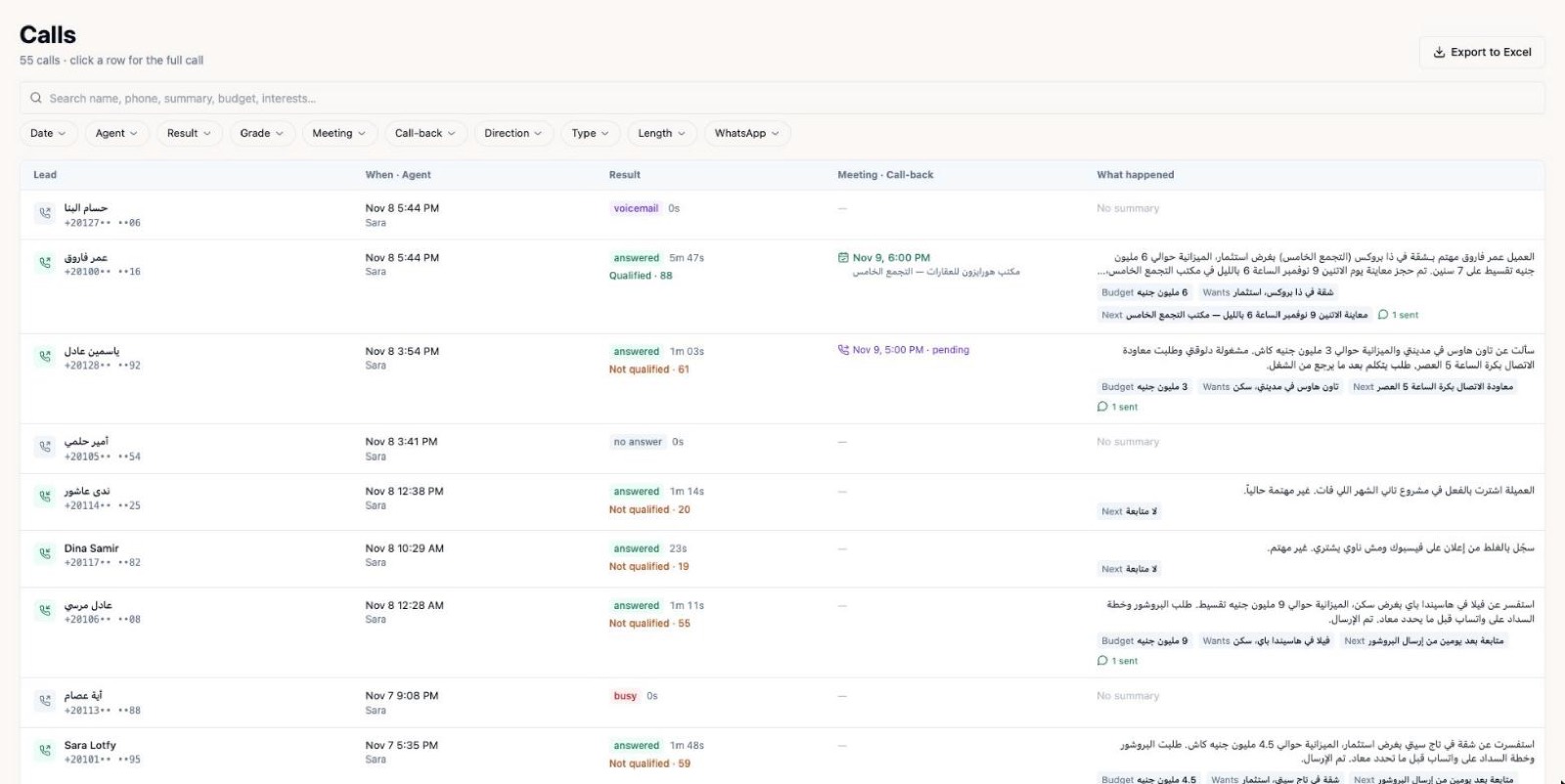
A typical flow: the call is answered instantly, the agent understands what the customer needs, qualifies the lead, books the appointment or handles the request, sends a WhatsApp follow-up, and the call appears in the dashboard with a recording and transcript.
What an AI voice agent should not do
A good agent knows its limits. It should hand over to a person when the caller asks for one, when the case is sensitive or when it is not sure. It should not invent answers it does not have, so give it accurate information about your services, hours and policies. A voice agent is a strong first line, not a replacement for your whole team.
Questions to ask before choosing one
- Can I hear real call recordings, not only a polished demo?
- Does it speak my customers' dialect and handle mixed Arabic and English?
- Can it book, update my CRM and follow up, or does it only answer questions?
- What happens when it cannot help: is there a clean handover with context?
- Can I review every call and see how the agent performed?
Frequently asked questions
Is an AI voice agent the same as a voicebot?
Mostly. Voicebot is an older and broader word for any automated voice assistant. An AI voice agent usually means a more capable one that understands free speech and completes tasks.
What is the difference between an AI caller and an AI receptionist?
An AI receptionist handles incoming calls to your business. An AI caller makes outgoing calls, such as reminders and lead follow-up. One platform can do both.
Do callers know they are talking to an AI?
That is your choice to set, and being honest about it is a good practice. What matters to most callers is that the agent is quick, clear and actually solves the problem.
Can it replace my staff?
It takes the repetitive calls and the ones that arrive when nobody is available. Your team stays for conversations that need judgment, empathy or negotiation.